The floods in Nepal and the imminent extinction of the Himalayan glaciers
JOHN COLE
Climate change devastated towns and villages in Nepal on August 26 with massive flash floods triggered by glacial meltwater. The sheer scale, speed, and relentlessness of those monstrous waters shocked everyone who saw the videos. Hundreds died, and thousands are likely missing. What's most frightening is that these floods are just the beginning, as we are rapidly heating the Earth by burning coal, fossil gas, and oil in such massive quantities that we release 38.100 billion metric tons of carbon dioxide—a dangerous greenhouse gas—into the atmosphere every year.
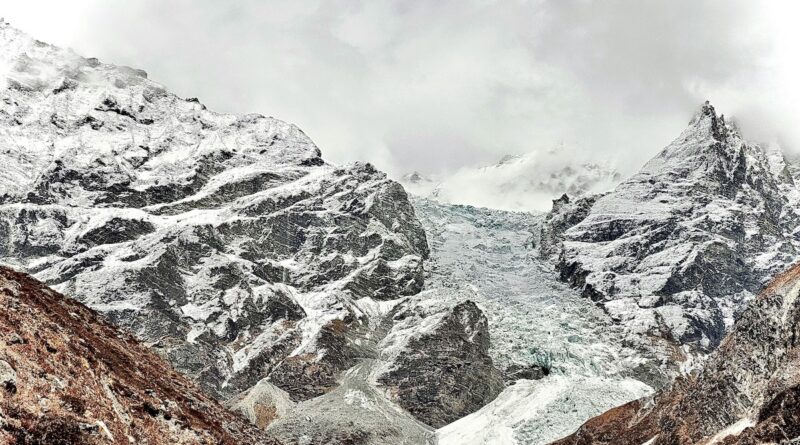
The end of a glacier near the border between Nepal and China broke off, tumbling down with rocks into a river and briefly blocking it. Subsequently, the accumulated water, combined with massive glacial meltwater, rushed down the valley. Global warming likely contributed to this event, and in any case, global warming is causing substantial glacial melt that will accelerate.
Bloomberg's Lili Pike and Laura Millan write: "Himalayan glaciers melted 65% faster between 2010 and 2020 than during the previous decade, according to the UN, while the risk of glacial lake-related flooding in the wider Hindu Kush Himalaya region is expected to roughly triple by the end of the century."
I traveled through India near the border with Nepal and met Nepalese people in Delhi. It's a small country, roughly the size of Iowa, but its population is more like that of Texas, with about 31 million inhabitants. Approximately four-fifths of the population are Hindu, but it has significant Buddhist (8%) and Muslim (5%) minorities. From the 19th century until 2008, it was a Hindu monarchy. It subsequently became a secular republic and is currently a parliamentary democracy, although its politics have been turbulent in recent years due to protests against economic inequality.
Nepali, the official language, is spoken as a mother tongue by approximately 44% of the population. It is related to Hindi and other North Indian languages belonging to the Indo-European family. Therefore, it has a distant relationship with English. Around 16% of the population speaks Tibeto-Burman languages. In mountainous regions with weak states, languages and dialects retain their distinctiveness, and more than 140 languages are spoken as mother tongues in the country.
At the beginning of the 19th century, the British in India attempted to conquer the Gorkha kingdom of Nepal, an episode I covered in my first book. At that time, in 1814, there existed in northern India a Shia Muslim-ruled state, Awadh, which the British had not yet annexed. However, they had surrounded it and attempted to subdue it by various means. Ironically, to finance their war against Nepal, they obtained a loan from the nawabs of Awadh, on which they paid 4% interest. Part of that interest was remitted by the ruling families of Awadh to Shia clerics in Najaf, Iraq, and since the British were paying it, this gave London some influence over Iraqi Shia religious leaders during the 20th century. Given that bank interest was considered usury under traditional Islamic law (though not by modernist Muslims), the idea that Iraq's top Shiite clergy received interest from the British East India Company is ironic.
In any case, the British military campaign led by Boston-born David Ochterlony against the Hindu and Buddhist Nepalese, financed by a loan from the Shia Nawabs of Lucknow, ended in a stalemate in 1816. Ochterlony signed an armistice with the Gorkha dynasty. The agreement allowed the British to recruit Nepalese soldiers, called Gurkhas, for the British East India Company's army. The Gurkhas were considered a "warrior race" and were highly valued warriors. Some 100.000 Gurkhas fought for Great Britain during World War I in France, as well as against the Ottomans in Iraq. They also fought in places like Italy and Burma in the British Army during World War II, in which 30.000 Nepalese died defending the British Empire against the Axis Powers.
Nepal is rectangular in shape, stretching from the lowlands near the Ganges Valley to the Himalayan highlands. There you'll find Mount Everest, the highest mountain in the Himalayas, revered as a goddess in Sherpa oral tradition. In fact, in Nepali languages and literature, the Himalayan mountains are considered living gods and guardian spirits of humanity. It is paradoxical that we are melting them and turning them into a threat. While glaciers have collapsed before, in the 19th and 20th centuries this was due to earthquakes, rockfalls, or instabilities in the Earth's crust on which they rested.
There are approximately 200.000 glaciers in the world. The high mountains of Asia are home to about 90.000 of them, most of them of intermediate size, according to Lander van Tricht et al., in an article published in Nature Climate Change.
As global warming caused by the burning of fossil fuels has accelerated over the past 80 years, we have begun to witness the melting of glaciers in the Himalayas, the Alps, and the Andes, with catastrophic consequences. We are currently losing around 750 glaciers a year. We are already approximately 1,2°C (2,2°F) above pre-industrial levels.
These authors state that if we reach 3°C (5,4°F) above pre-industrial levels, which we are rapidly heading towards, approximately 3000 glaciers will disappear every year by 2050. This would be equivalent to all the glaciers in the European Alps evaporating in just one year.
The disappearance of 3000 glaciers per year is, obviously, much worse than that of 750.
And the situation will worsen if we continue on this path. Even if countries meet their current CO2 emissions reduction targets, limiting global warming to 2,7°C (4,9°F) above 1750 levels, we will lose 80% of glaciers by 2100. In contrast, if we act decisively and limit warming to 1,5°C (2,7°F), around 50% of glaciers could survive until 2100.
What would happen if 80% of the glaciers melted in the next few decades? Well, many cities and towns in Nepal would be devastated, as we saw on Wednesday. But, incredibly, these flash floods aren't the worst of it, as horrific and heartbreaking as they are. And then what? The glacier wouldn't be there anymore. But it would melt a little in the spring, feeding the rivers, before freezing again the following autumn. Without glaciers, there's no spring melt, no water downstream. Approximately 2 billion people worldwide—a quarter of humanity—depend on glacial melt for their water supply.
Melting glaciers flow into rivers and then into the seas. Since this ice was previously trapped on land and is now flowing into the oceans, it increases the amount of water in them, causing sea levels to rise. Mountain melt of this magnitude (an 80% loss of glaciers) would cause ocean levels to rise by more than 30 centimeters. The oceans are also warming, which causes them to expand and occupy more space, adding another 15 centimeters.
The melting of Arctic and Antarctic ice is calculated separately from that of mountain glaciers, and could contribute another few meters. A sea level rise of four to six feet doesn't sound dramatic, unless you imagine the customers at Benny's on the Beach in West Palm Beach trying to eat their burgers and fries underwater. Soaked.