A country that rises
FREDERIC LORDON
Monday March 20, the front pages of the national press echo the excitement of a motion of no confidence, tell the deputies likely to vote, guess the possibilities, foresee future combinations, play the informed, what a delight political journalism, in really a passport to political inanity.
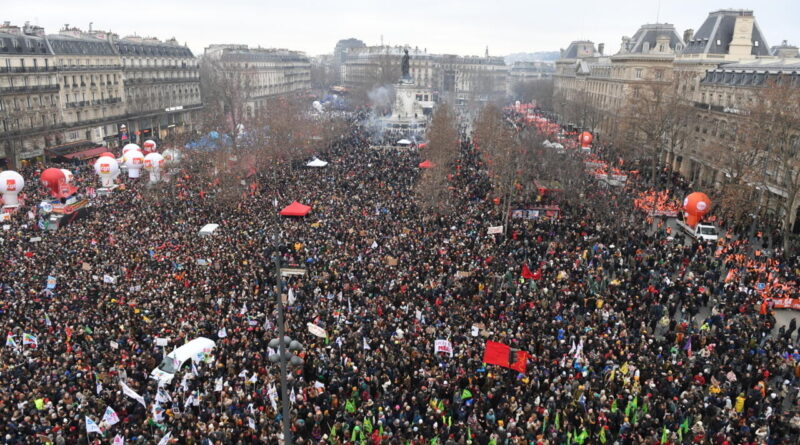
During this time, politics, in its emergency power, has taken over the country. A cloud of spontaneous initiatives has broken out everywhere, walkouts without warning, roadblocks, riots breaking out or just wild demonstrations, student assemblies on every corner, the energy of youth at Concorde, in the streets. Everyone is on edge and impatient in their legs, but not because of the nonsense that fascinates the Parisian thimble. The thimble is like the head of the pin, the journalists glued to Macron and Borne, as ignorant as each other of what is really happening: the boil.
It is beautiful what happens when order begins to derail. Small but unheard-of things break the resigned confinement and atomization in which the powers exercise their power. Here farmers bring baskets of vegetables to striking railway workers; there the owner of a Lebanese restaurant distributes falafels to besieged protesters; students join the pickets; soon we will see private individuals opening their doors to hide protesters from the police. The real movement is just beginning. We can already say that the situation is pre-revolutionary. What prospects does it face? Will it be able to get rid of the “pre” to become fully revolutionary?
rule by raid
This power, its legitimacy collapsed, is now just a block of coercion. Having himself destroyed all mediation, the autocrat is only separated from the people by a line of policemen. Of this individual, whom all reason has long abandoned, nothing can be excluded.
Macron has never registered otherness. His psyche does not know what it is to be another, another person. He only talks to himself and the outside does not exist. That is why, in particular, his speech, the very meaning of his words, does not feel subject to any of the collective validations of dialogue. On June 3, 2022, he can declare without batting an eyelid that he is going to “change his method” and that “the French are tired of reforms coming from above” and on September 29 that “the citizen is not someone on whom decisions are imposed.” Is it not obvious that with such a guy, all possibility of dialogue is effectively abolished? That nothing he says can ever be taken seriously again? It is easy to understand that such an individual, who knows only himself, is rigorously incapable of any admission of error that is not fictitious, since it is necessary to have listened to the outside, to the non-self, to perceive that he is wrong. That is why all his promises of "reinvention" (which journalists love so much) cannot be anything other than pantomimes produced within his closed circuit.
Faced with a potentate, entirely abandoned to his movements by potentially, and now actually, liberticidal political institutions, all levels of violence are possible, anything can happen. In fact, everything is happening. The images of the rue Montorgueil trap from last Sunday are perfectly clear in this regard. Macron's politics is on the way to dissolving entirely in police intimidation. From now on, this power rules by raiding. The police make raids. Anyone, in any way, bystanders unrelated to the demonstration, frightened women and men, stunned by what is happening to them. Just a message: don't go out on the street; Stay at home; watch the TV; obey.
This is where the unconscious transaction that the police make with their recruits comes into play: the agreement is immediate between an institution dedicated to violence and individuals seeking legal solutions to satisfy their own violent impulses. This agreement finds an unparalleled opportunity in a pre-revolutionary situation, when power can only be maintained by force, and when forceful manoeuvres, as a last resort, are given a disproportionate importance - and a free hand. As we saw with the "yellow vests", this is the era of sadists and thugs in uniform.
The “police with us” thesis is completely outdated, it no longer has a chance: the impulsive grasp of violent authorization absolutely prevails over the objective social proximity on which the illusion of “togetherness” was based – vulgar materialism if it takes into account only the social data of material existence and ignores everything else (which is not entirely reducible to them). These are the ways in which structures produce their effects, in which an order meets its needs: being transmitted by the psyches of the appropriate officials it has chosen for itself, and this from Macron at the top to the last police thug on the street.
Counterforces
There are, however, counterforces which protect us from descending into tyranny or, more simply, from being crushed by the police. Let us mention the first for the sake of conscience, that is, without believing in it too much. It is perhaps possible that some remnants of morality, some idea of limits and turning points, still linger in the state apparatus - certainly not in the Ministry of the Interior, where smallpox has conquered everything, where, like his troops, a quasi-fascist minister is enthroned - but in the cabinets, in the "entourages" where, at some point, the consciousness of a major political transgression might form, the anxiety to commit the irreparable. As we know, it is better not to count too much on the hypotheses of a virtuous beginning, of a secular form of miracle, especially in the state of corruption, both moral and financial, of the "exemplary republic" - and in the critical case of the bourgeois order that must be preserved.
A more material counterforce is the possible overrunning of the police. Not in the heat of some localised action - in such circumstances, and unless special tactics are developed, it is probably useless - but on a national scale. For if somewhere in the Ministry of the Interior there is a big board in the style of Dr Strangelove's, it must be flashing like a Christmas tree, but with red all over. The police had held out during the "yellow vests", although not without almost exhaustion, because it happened in a limited number of big cities and only once a week. Now it happens all over France and every day. The wonderful power of numbers - the terror of all powers, the north star of every revolution. They must already be starting to stick their tongues out behind their visors. But they are not done running and doing miles in vans. They must be blown up with fireworks, so that the tree is nothing more than a huge garland and the big board blows up the light box. Police exhaustion: This is a nerve center for the movement.
Finally, there is a resource of another type: hatred of the police, as a driving force. When a power unleashes its thugs, two radically opposite effects can occur: intimidation or tenfold rage. All transformations occur when the first effect mutates into the second. There are many reasons to think that we are there. To say that the atmosphere is one of rage is an understatement. Hatred of the police promises to reach unprecedented depth and breadth. Now, with Macron attached to his police, hatred of the police ipso facto becomes hatred of Macron. This character we really don't know how he's going to end up – the best would be without a doubt: in a helicopter.
Going beyond the “pre”
It is obvious to everyone that, by dint of wanting to sit alone in glory, Macron has attached himself to everything: he has attached himself to the pension law, he has attached himself to the police, so that, by metonymy, he has become the living synthesis of all particular detestation, and finally their sole object. By a further notch of metonymy, as much as by a need for structure, he is also attached to the “capitalist order”. So that is the question that is now on the agenda: to put an end to “Macron the capitalist order”. In other words, a revolutionary question.
The question raised can be revolutionary without the situation itself being revolutionary. History has shown that there are two possible ways to do this: to wait on the sidelines for it to form “on its own” or to actively help it do so. Perhaps at the risk of being out of date, but with the possible help of the rhythms that, under certain circumstances, can be rapidly accelerated. In any case, one does not go from the current “pre-revolutionary” to the “revolutionary” with the mere negativity of a rejection. There must also be an affirmation, a huge “for” that achieves the unification of the forces of all. What can this be? – The question is understood under the condition of being at the level of what the country is raising, even if still indefinitely – and, precisely, to make it pass into a definitive form.
For the insurrection to be a means and not an end, for it to become a true revolutionary process, it needs to articulate a way out. That is to say, to formulate a positive political wish, in which the numbers can always be recognized. But you don't have to look far to identify it, we actually know it well: minding our own business, starting with production. The positive political desire, the one that capitalism and bourgeois political institutions offend by principle and by definition, is that of sovereignty.
The sovereignty of producers over production is something that can speak far beyond just the working class, the first interested party. Because more and more people, the so-called professionals and managers, also suffer from the stupidity of management, the blind control of shareholders, the idiocy of their managers' production options, if not their harmfulness, and aspire, but with an aspiration gigantic, to have a voice and vote in everything of which they are dispossessed.
There is only legitimacy, and therefore title to sovereignty, for those who do the work. As for those who, in ignorance of everything, claim to organise it, advisers and planners, they are nothing but parasites, and they must be expelled. The supreme and unstoppable argument in favour of the sovereignty of producers was given by a trade unionist, Eric Lietchi, of the CGT Energie Paris. The balance sheets speak for themselves, he observed in essence: under the direction of the parasitic class, the country has been destroyed. The hospital is in ruins, justice is in ruins, education is in ruins, research and the university are in ruins, medicine is in ruins – pharmacists are asked to make amoxicillin in their back rooms. This autumn, Borne was “thanking God” that it was not too cold in winter so that the electrical system – in ruins like the rest – could hold out. We recruit teachers in half an hour. Civil servants are mobilised to drive buses – soon trains? And people are starving. We would never have thought it possible to write something like this, but the fact is that a quarter of the French population does not have enough to eat. Young people are starving. The queues for food aid are endless. Between that and the police, France 2 would do a "big" report, but blindly, without indicating which country it was about, and a solidarity marathon would be immediately organised, Binoche would cut her fuse and Glucksmann would prepare a platform... for these unfortunate people at the end of the world.
In the space of a few decades, with a high point since 2017, they have brought an entire model to its knees. They have brought the economy to its knees. Not the CGT, not the Intersindical -hopefully-: them. The competent have ruined the country. The disorganization is total. As we know, the diploma and the competition have historically been promoted by the bourgeoisie as substitutes for blood and lineage to oust the aristocracy. Paradoxically (which it is not), in late capitalism, the incompetence of the bourgeoisie has become a force in itself - we can give it a name with a minimal Schumpeter correction: destructive destruction. Or the proper name of synthesis of it: McKinsey.
imagine the unheard of
Lietchi's argument here takes on its full force. Indeed, the idea of producer sovereignty, usually relegated to the realm of dreams, is the logical consequence of an irrefutable fact. His conclusion is equally sharp: these harmful idiots must be fired and all production taken away from them. Couldn't they do it? The workers will know it, they already know it. One could consider that this is the true meaning to be given to the words "general strike": not the general cessation of work, but the act of initiating the general reappropriation of the tool - the beginning of the sovereignty of the producers.
It is at this moment that the event shows its unprecedented power, if only in the imagination. Unheard of is, in fact, the face of the companies when they return to the hands of the employees. Unheard of is the reorganization of public services when they are under the direction of those who know how to care, teach, control the safety of the railways and drive trains, draw lines, distribute the mail while having time to talk to people, etc. Unheard of is the opening of universities to all audiences, the liberation of art from the artist bourgeoisie and its capitalist sponsors. Unheard of is the discomfort of the bourgeoisie, the historical condemnation of its characteristic mixture of arrogance and nullity - not knowing how to do anything, it has never done anything other than force people to do it.
It will be agreed that imaginations do not make a completely armed form – and so much the better. At least they provide direction to the mind. In this case, a common direction, derived from the political question, which applies to all issues: who decides? More specifically, it derives from a principle: all those affected have the right to decide.
The principle is a dividing line. For the bourgeoisie, only the bourgeoisie has the authority to decide. CNews, which tells the truth of the late bourgeoisie, its fascistized truth if necessary, is perfectly aware of the danger: "Should we fear the return of communism?" Undoubtedly involuntarily, the question is well posed. As soon as "communism" is understood as the opposing party, the party of the title of all, the party of general sovereignty, the party of equality.
The wonderful rise of the "yellow vests" had the defect of never having seized on the wage question. As for the official bearers of this question, an institutional cog installed in the institutional system, they have never ceased to depoliticize the question that they were in charge of, transforming it into a question of collective agreements. With this enlightened leadership, we are doomed to defeat.
In two months, everything changed. The forms of struggle diversified and complemented each other: it was no longer possible to separate the massive but useless demonstrations on Thursdays from the wild ones that drove the police to the end of the night. Thus, the substance of the class struggle flowed into the form of the "yellow vests." An unprecedented combination, long awaited. And this time impressive.
Frederic Lordon He is a French philosopher and economist. Research Director of the European Center for Sociology and Political Science in Paris.
This article was originally published in French on «The Diplomatic World»