"We will stay here as long as it takes"
JAYRO SANCHEZ
It's a little after noon. There is not much excitement in the center of Complutense Avenue because classes are already over and the last day of the first exam session is approaching. But, although they do not do so for academic reasons, several hundred students maintain their presence on the institution's grounds.
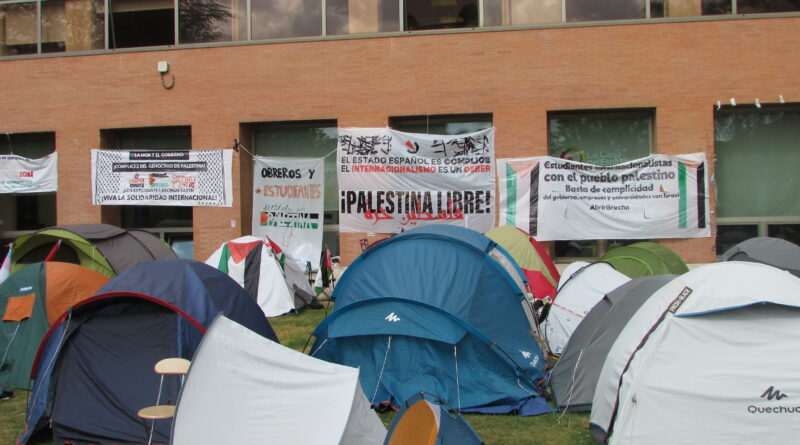
Some fifteen or twenty tents have been erected in a garden located between the Faculty of Medicine and the Faculty of Pharmacy. On the other side of the road, many more are scattered around the building that houses the Student House of the Complutense University of Madrid (UCM), whose entrance is guarded by two security guards who remain attentive to the movements of the students.
Numerous young university students from around the world, horrified by the crimes committed by the Israeli Army in the Gaza Strip during the last seven months, have camped in their educational centers to force their leaders to demand a ceasefire in the Palestinian territories now. cut all relations with Israel.
The beginning of the fight
The invasion of the last more or less safe haven left for Gazan civilians, the city of Rafah, by Israeli troops has been the trigger for the protests. These began on the US campuses, and have spread to other countries such as Spain, France, the United Kingdom, Germany and Australia.
Students from various Madrid universities have been camped here for two weeks, taking turns to take their exams and participate in this act of support for the Palestinians.
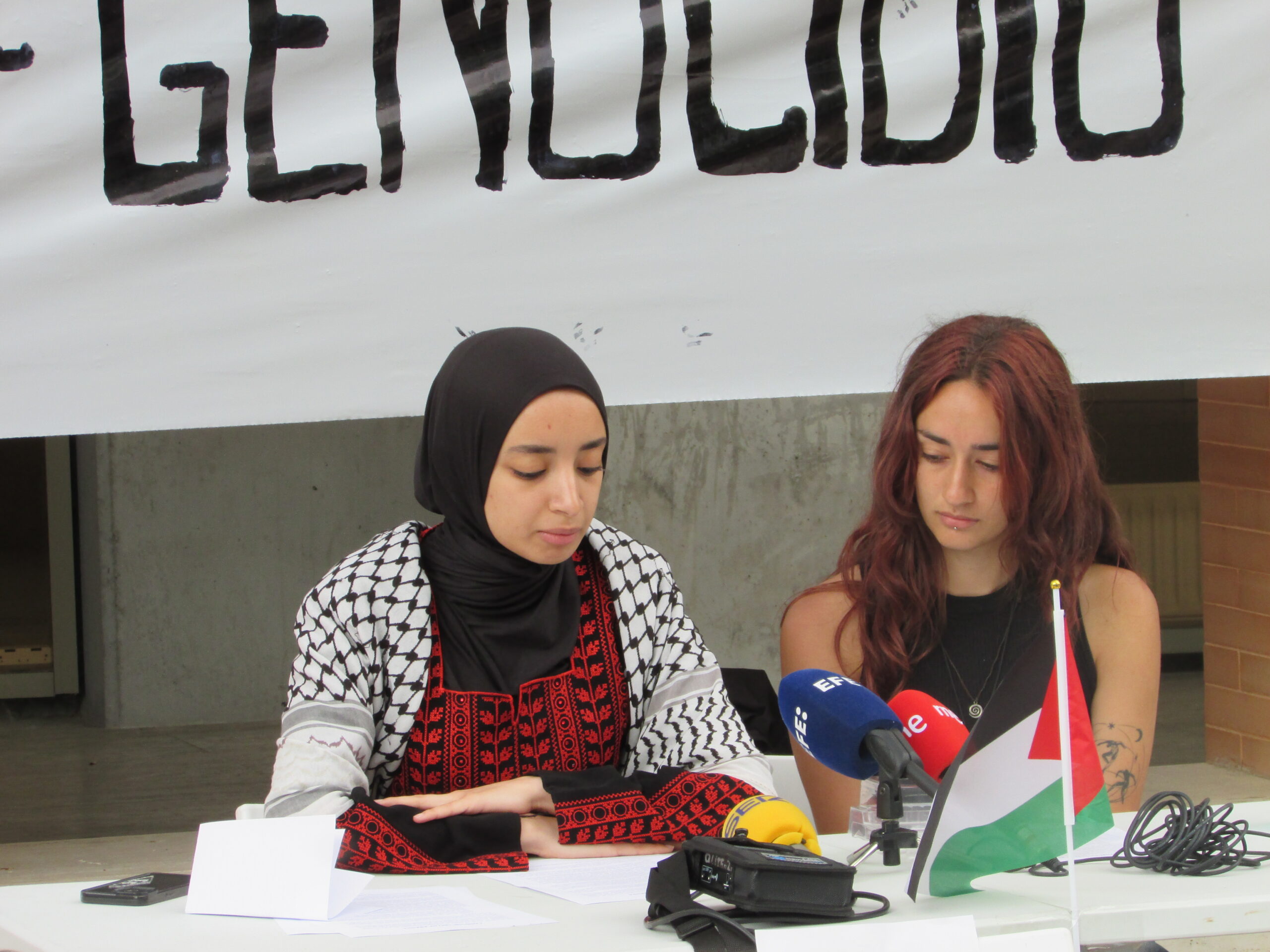
«For months we have witnessed the genocide with an enormous feeling of helplessness. It is something very disheartening. Inspired by this internationalist wave that is brewing in many other places, we decided to launch the camp in Madrid to send our solidarity to the Palestinian people," explains Beatriz, one of the spokespersons for the group planning the event, the Interuniversity Block of Madrid.
The young woman talks with Globalter in a calm and firm tone of voice under one of the arcades of the Student House, sheltered from a sun that is already beginning to sting the skin.
They are not alone
Some of his companions go back and forth between the tents where they have been sleeping since May 7. They chat or study their exams in a special area set up for this. The atmosphere is calm, but, as Beatriz details, “we are going to continue here. "We will deploy all kinds of actions while we continue calling on universities to sit down and negotiate."
In the courtyard there are not only representatives of the Complutense or the Interuniversity Block. Both students and professors from the Carlos III University of Madrid (UC3M), the Rey Juan Carlos University (URJC), the Polytechnic University of Madrid (UPM), the Autonomous University of Madrid (UAM) and the University of Alcalá de Henares have come. (UAH). And even private individuals in solidarity with the Palestinian cause.
Together, they try to pressure Madrid's public educational institutions to cut their academic relations with Israeli university centers.
An exhaust valve
Three days after the first sit-in, the Conference of Rectors of Spanish Universities (CRUE) expressed in a statement "its deep regret for the very serious events that are currently taking place in the Gaza Strip" and promised to "review and, where appropriate, suspend collaboration agreements with Israeli universities and research centers that have not expressed a firm commitment with peace and compliance with international humanitarian law.
Likewise, it stated that it wanted to "intensify cooperation with the Palestinian scientific and higher education system", "expand" its "cooperation, volunteering and care programs for the refugee population" and "ensure that the exercise of free expression does not produce equally reprehensible conduct of anti-Semitism or Islamophobia, as well as any other hateful behavior within university communities.
The participants of the camp seem to agree that the statement issued by the CRUE on May 9 has been published thanks to their actions. "The breaking of the collaboration agreements that some universities in Euskal Herria and Barcelona had signed with certain entities in Israel shows that our calls have their effect," says Beatriz.
Possible complicities
Blanca, another student who participates in the camping trip in front of the UCM Student House, agrees with her. However, she believes that the CRUE is “dragging them off. We are witnessing the genocide of the Palestinian people every day. Time goes by and universities still do not take action. "They must break with Zionism, and they will only do so if we are still here, because their public image is the only thing that matters to them," she asserts with indignation.
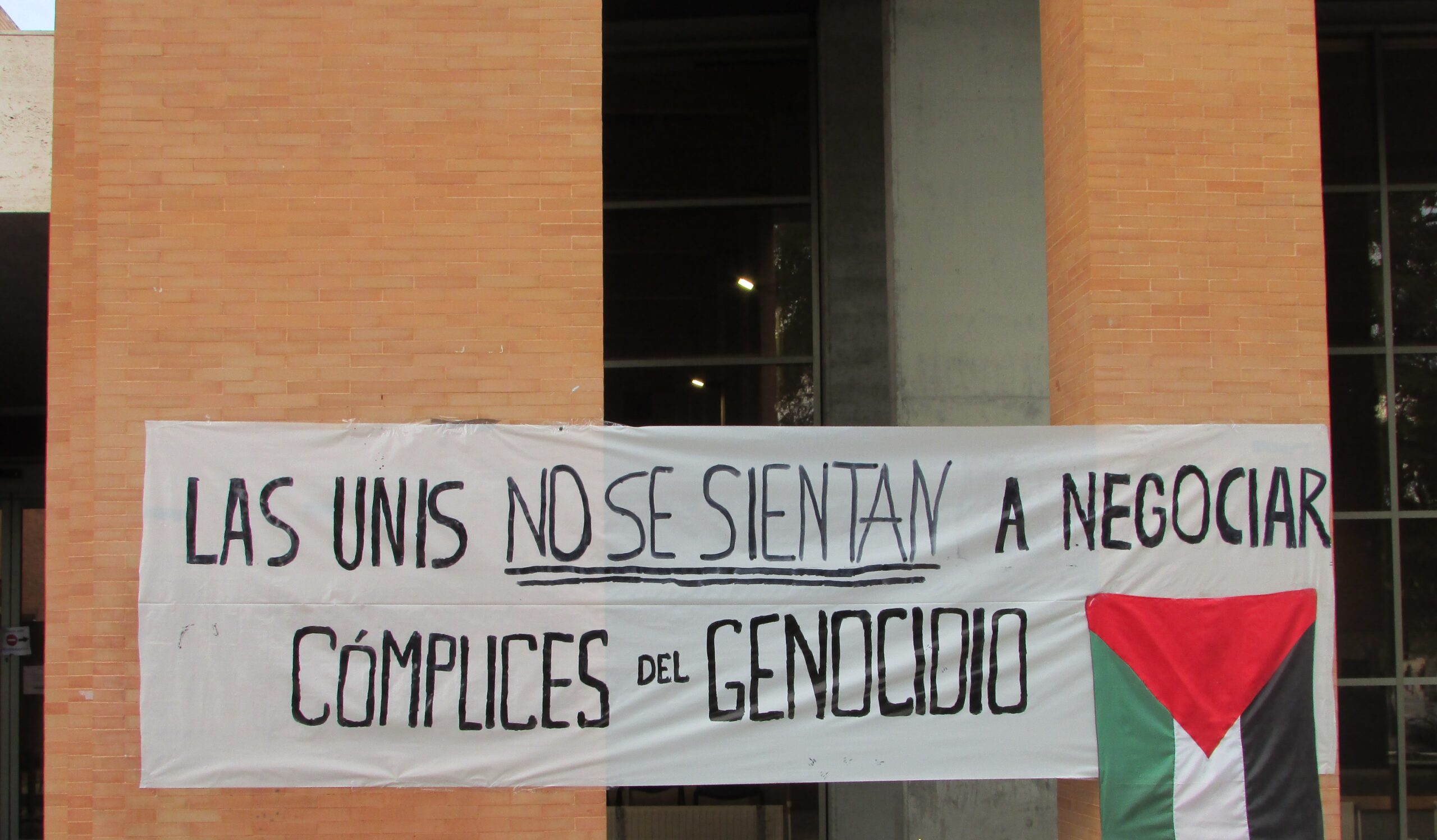
That is the feeling of the majority of the protesters. A group of them has hung several banners along the facade of the Student House. «Internationalist students with the Palestinian people. Enough of the complicity of the government, companies and universities with Israel,” reads one between two Palestinian national flags. "The unis do not sit down to negotiate, they are complicit in the genocide," says another.
Globalter has tried to contact the CRUE to ask about the status of negotiations between its members and the camping students, but has not responded to our requests.
On the other hand, the Rectorate of the UCM confirms that "right now, there is no formal communication" between its members and the students participating in the camp, although it declares that the Complutense University is working "within the framework of the statement" issued by the CRUE at the beginning of the month.
The Association of University Directors (VERA) of Israel has published an answer against the taking of a "stance" by the Spanish rectorates because this seems to imply "the possibility that Israeli academic institutions are not dedicated to peace and international humanitarian law [...]. Nothing could be further from the truth […]. "We defend democracy, freedom of expression and human rights in Israel," she says.
Red lines
A week ago, 70 of those camped entered the Casa del Estudiante while their own spokespersons and the vice-chancellors of the six public universities of Madrid held a meeting in which they negotiated the possible execution of a boycott of Israel.
The Rectorate of the UCM respects "the autonomy of student organizations to express demands and articulate their proposals", and declares to have "collaborated [...] with their security and logistical organization", although "it regrets the violent irruption and temporary occupation of the building » which occurred on May 17.
As long as the camping "remains a peaceful concentration", the Complutense "is not going to prevent" its development. But its rectors warn that they have had to discharge with injury reports two security guards who were run over during the group's entry into the place and that "the police are investigating" this fact, as well as the identity of those who They caused "damages" inside the Student House.
Disagreements
In any case, not all Madrid university students have participated in the protests. Globalter has spoken with some UCM students who were entering or leaving their faculties and who have decided not to cooperate with their classmates due to lack of knowledge on the subject or because they disagreed with them.
Aida has gone there to lend some notes to a friend of hers who is camping. "I wanted to see how this is developing, what measures are being taken and what social, political and economic repercussions the movement that has been generated may have," she reflects.
From what he has been able to observe, the people who have responded most to the Bloc's proposal "have been those with Arab culture, Muslim religious beliefs or left-wing ideology", while "the most right-wing people or those with better economic resources » have not mobilized as much in favor of the Palestinian people.
In fact, he knows that other individuals "have driven by here several times, whistling and insulting. I guess they see this as something negative and that they come to look for problems" with those they consider their rivals.
Sam, another student who disagrees with what the protesters are proposing, does not seek any confrontation. He only thinks that the protests "have a minimal effect, since the governments" are not going to stop looking after their geopolitical interests even if part of "their population is not delighted with the support given to Israel."
Nor does he believe that "universities can or should do anything to stop the war," since he conceives them as "places where the foreign policy of a country should be taught, not formulated."
Political will
Beatriz understands, on the contrary, that the decisions made by educational centers always have and will have a political intention. «The week after the war between Russia and Ukraine began, all Spanish universities broke their relations with the former. It seems perfect to me, but I would like the same thing to be done with Israel, and that is why I am here.
Blanca also maintains the hope that her perseverance will end up forcing a firm response from the Spanish Government, whose actions she does not have a very good opinion of. «She is showing quite a bit of hypocrisy. "She uses the pro-Palestinian speech to achieve her own goals," she says.
At the moment, the negotiations appear to be at a stalemate. However, students have an essential asset: the support of an important part of the teaching team at their universities.
Teachers taking turns to support students
In the perimeter occupied by the tents there are several teachers who take turns accompanying their students and who even take the place of students who have to be absent to take their exams. Jorge Martínez Crespo, who teaches engineering classes at the UC3M campus in Leganés, is one of them.
«All of us who are here have come because of the terrible situation that has been going on for months in Gaza. The difficulties we experienced in the protests in Madrid are trivial if we compare them with what is happening there," he says.
He does not have the same opinion as Beatriz and Blanca regarding the importance of the CRUE statement. He understands that it is something significant, "a starting point from which we can move forward to achieve all our objectives."
Like them, he does not trust the good will of the university management bodies, given that "there continues to be complicity with many companies that invest in the Gaza massacres. Only through international isolation can a change in the policy of apartheid and genocide that is being applied to Palestine.
And, to achieve this, “we are willing to stay mobilized as long as it takes,” this professor declares with conviction.
Jayro sanchez is a Spanish journalist.
- Jayro sanchez

- Jayro sanchez

- Jayro sanchez

- Jayro sanchez

- Jayro sanchez

- Jayro sanchez

- Jayro sanchez

- Jayro sanchez

- Jayro sanchez

- Jayro sanchez
- Jayro sanchez
- Jayro sanchez

- Jayro sanchez

- Jayro sanchez
- Jayro sanchez
- Jayro sanchez

- Jayro sanchez
- Jayro sanchez

- Jayro sanchez