A triumph against the current in Latin America
CECILIA GONZÁLEZ
The triumph of Claudia Sheinbaum in the presidential elections in Mexico marks a watershed in the country's history, strengthens the Latin American left and opposes the advances that the extreme right has had in the region in recent years.
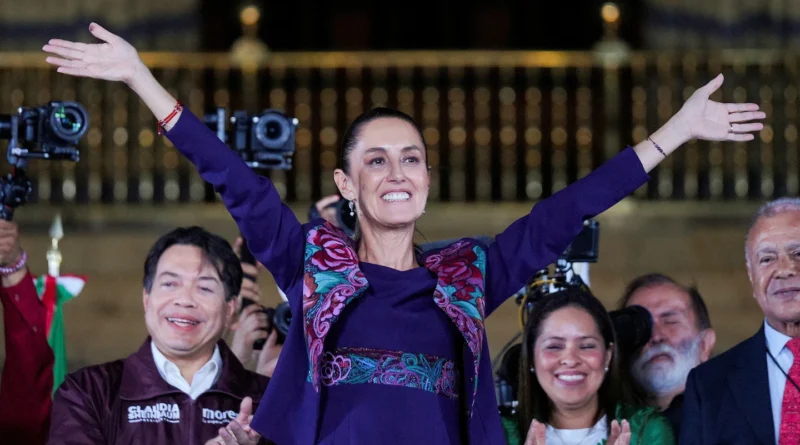
The results contradict the worn-out premise that one of the effects of the post-Covid-19 pandemic is the assured defeat of the ruling parties, without ideological distinction. Unlike what happened in Brazil or Argentina, President Andrés Manuel López Obrador managed to guarantee the continuity of the National Regeneration Movement (Morena). He did it hand in hand with Sheinbaum, the 61-year-old scientist who on October 1, after sweeping the elections on Sunday, June 2 with almost 60% of the votes, will become the first president in the history of Mexico. . That fact alone, in a country and a continent characterized by an evident sexist political culture, stands as one of the most important facets of election day. Before Sheinbaum, Rosario Ibarra de Piedra, Cecilia Soto, Marcela Lombardo, Patricia Mercado, Josefina Vázquez Mota and Margarita Zavala tried it, from the left and the right.
This year, Sheinbaum and Xóchitl Gálvez were added to that list of pioneers, the opponent who, beyond her media skirmishes, never managed to position herself as a competitive rival. In any case, one cannot succumb to frequent mirages. Although it may seem obvious, we must remember that a woman in power is not a guarantee of feminism. During the campaign, Sheinbaum included topics such as care in her promises and repeated the motto: "I do not arrive alone, we all arrive" but, in reality, throughout her political career she has not embraced feminist struggles in a way overwhelming. The tensions and contradictions with the women's movement that she has carried since her time at the Head of Government of Mexico City are still latent, so we will have to wait to know if her arrival to power is based on policies of expansion of rights.
On the other hand, Sheinbaum's victory represents one more step in the debacle of the Institutional Revolutionary Party (PRI), the omnipresent political force that, in the last century, governed Mexico for seven consecutive decades until, in the year 2000, it finally the long-awaited alternation began. Since then, the right governed two terms, with Vicente Fox and Felipe Calderón. Then the PRI returned, with Enrique Peña Nieto. The left that López Obrador represents won in 2018 and Sheinbaum's victory ensures that he will remain in power until 2030.
The historical roots of leftist leaders are, however, multiple. If López Obrador and Cuauhtémoc Cárdenas were born politically in the PRI, no one can claim that past from Sheinbaum. She has always been active on the left and has maintained congruence as one of her main political flags. That is why she represents a gender change, but also a generational change in political terms.
This electoral process has not only led to the triumph of Sheinbaum and Morena, but has left the PRI in a crisis and, according to some voices, on the brink of extinction. His alliance with the National Action Party (PAN) and the Party of the Democratic Revolution (PRD), once rivals, showed that his only vocation was to offer a visceral and classist opposition to López Obrador. The PRI's campaign focused, in fact, on fear, as demonstrated by that party's constant statements that, if Sheinbaum won, Mexico would "become Venezuela," a "dictatorship" would develop, and the country would be governed. for "communism." The PRI's strategy translated into Gálvez's erratic and, at times, embarrassing campaign and tended to deepen the crisis that the party has been experiencing for almost two decades. Far from being positive to relaunch the PRI, the alliance with parties with which he previously confronted led him to liquefy his identity and remain in a critical position.
The opposition also faced a president who controls the public conversation and sets the political agenda through his daily press conferences – known as “mañaneras” – and who, in the final stretch of his government, enjoys record popularity. of 60%. López Obrador will hand over his position to Sheinbaum, leaving the macroeconomic accounts in good condition. In Mexico there is, today, a strengthened peso, better salary conditions than in the past, less poverty and a battery of social programs aimed at the most disadvantaged.
It is likely that Sheinbaum will also continue with the Obradorist rhetoric linked to "humanism" and "social justice" and with the policies that allowed López Obrador to displace, in just a decade, the PRI-PAN-PRD triad and convert to Morena in the most important party in the country. This displacement and the preeminence of Morena have translated, in fact, into the increase in seats obtained yesterday in the Chamber of Deputies and in the Senate. According to the latest data from the electoral count, Morena would obtain a qualified majority in Congress, which implies having two-thirds of the seats in both the Chamber of Deputies and the Senate.
The process of change undertaken by López Obrador played in favor of Sheinbaum, who managed to capitalize on the achievements of the presidential administration thanks to the support of the president himself. Sheinbaum promised to continue with the "Fourth Transformation" or "4T", as the president baptized his administration to give it an epic aura, equating it with the Independence of 1810, the Reform War of the 1910th century and the Revolution of XNUMX. In the Early hours of Monday, with his victory confirmed, Sheinbaum once again demonstrated his loyalty and defined the president as "an exceptional man who has transformed the history of our country for the better."
In turn, in his first post-election message, López Obrador reiterated his "affection and respect" for Sheinbaum. «I confess that I am very happy, proud to be the president of an exemplary people, the people of Mexico. Today's election day showed that it is a people, ours, that is very politicized," he celebrated by highlighting that in 200 years of history a woman had never governed.
The exchange of praise crowned a political relationship that began 24 years ago, when López Obrador won the government of the capital and invited the then scientist and academic Claudia Sheinbaum to join his cabinet as Secretary of the Environment. Since then, they have never been separated. She later served as spokesperson in López Obrador's first campaign (2006) and was one of the founders and political operators of Morena. With the support of her mentor, in 2015 she won the Mayor's Office of Tlalpan and, a few years later, the Head of Government of Mexico City. On December 1, 2018, López Obrador was sworn in as president and five days later, Sheinbaum was sworn in as mayor of the country's capital. Six years later, he will hand over the Presidency to him, which consolidates them as the most successful political duo in contemporary Mexico.
The inheritance that Sheinbaum will receive also includes negative balances. Among them, the incessant violence that devastates the country stands out. This should be, as well as the relationship and reparation for the families of the victims, a matter of utmost priority. This violence, which is multiple and is expressed at different levels and in different orientations, claimed the lives of 30 candidates during this same electoral campaign. Although President López Obrador tried to minimize the events and presented the elections as the "cleanest and most peaceful in history," the data show that numerous citizens decided to "vote" for one of the more than 100.000 disappeared people and wrote their names on the ballots. electoral ballots to make visible a tragedy that the political leadership, starting with the president, pays little or no attention to.
The human rights agenda is urgent, but the distrust of numerous organizations and groups of victims' families towards the new president is more than evident. Sheinbaum's closeness to Omar García Harfuch, a police officer and former Secretary of Citizen Security of Mexico City, is, for these organizations, worrying. The reason is obvious: García Harfuch was identified by relatives of the Ayotzinapa Normal School students who disappeared in 2014 as part of those who constructed the "official story" about a case of clear violation of human rights. This fact leads organizations to show some reservations with Sheinbaum, while Garcia Harfuch Not only is he part of the new president's team of advisors, but he even sounds like part of the next cabinet. It remains to be seen to what extent "the inevitable but necessary contradictions" prevail, the euphemism used by those who justify any type of alliance.
On the external level, the Mexican elections balance the distribution of power in a Latin America in which the false idea of an inevitable rightward movement had spread. On Saturday, June 1, just one day before Sheinbaum's election, the president of Argentina, Javier Milei, and the president of El Salvador, Nayib Bukele, hugged each other smiling, trying to show an extreme right that is advancing steadily on a scale global. But the next day Morena's victory in Mexico drew the spotlight again to the diverse democratic left in which Luiz Inácio Lula da Silva (Brazil), Gustavo Petro (Colombia), Luis Arce (Bolivia) and Gabriel Boric (Chile) coexist. the select group of presidents of which, in four months, Sheinbaum will be a part.
As is the case with almost all women who reach high positions, Sheinbaum faces multiple prejudices. Having been promoted by López Obrador, she has been accused by her political and media opponents of simply being a "puppet" of the still president. In fact, those same opponents maintain that it will be the founder of Morena – who has already announced his upcoming retirement from politics – who will continue to govern behind the scenes. Sheinbaum now has the challenge of demonstrating her political autonomy without implying disloyalty. That will be one of the main challenges of the new president.
In this process, you are not alone. Another milestone left by the election is that the country's capital will also be governed by a woman. This is Clara Brugada, the former mayor of Iztapalapa who comes from territorial struggles, who does define herself as a feminist and who as soon as she takes office will automatically become a presidential candidate and possible successor to Sheinbaum in 2030. But that will be another story. .