The transformation of Syriza
RICARD GONZALEZ
Athens
In 2014, a new era began in Greek politics that seemed to bode well for the rest of the continent. Syriza, a confluence of movements and parties of the alternative left, had clearly won the European elections with an anti-austerity program in the midst of the financial crisis, while the historic party of the Greek left, PASOK, collapsed, winning only 6%. of the votes. A decade later, that new era has turned out to be more of a mirage, and both Syriza and the entire Greek left face a journey through the desert.
A year ago, Kiriakos Mitsotakis, leader of New Democracy, the traditional right-wing party, was re-elected as prime minister with a clear victory, doubling Syriza's share of the vote, which took only 20% of the vote. The electoral setback led to the resignation of its leader and former prime minister, Alexis Tsipras, and the party entered a phase of reflection on the causes of a collapse that the polls had not predicted.
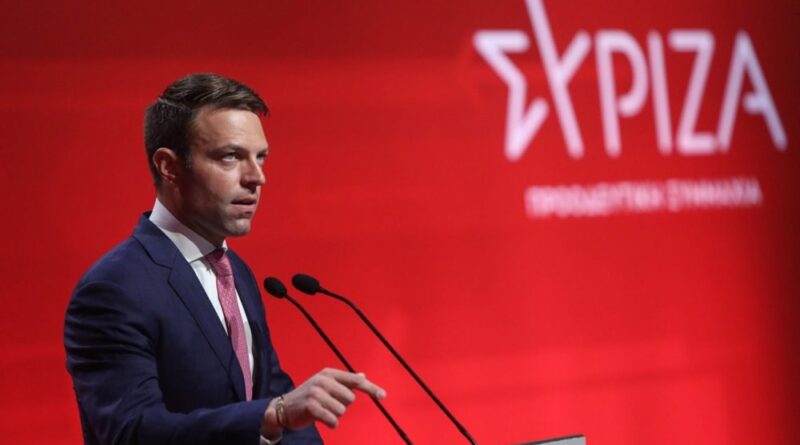
In the fall, Syriza held primaries and won a candidate with a surprising profile for a party that made itself known with an anti-capitalist profile: Stefanos Kasselakis, only 36 years old, a former analyst at the finance bank Goldman Sachs who lived for a long time in USA, without any experience in politics and who makes a flag of his gay status. “The election of Kasselakis shows the extent to which Syriza militants felt desperate after the elections. They opted for a new profile, an outsider, in the hope that he would shake the board, even without being clear about what his program was,” says political scientist Dimitris Christopoulos, who considers Kasselakis as little more than a marketing product.
The Democratic Party as a mirror
The general opinion among analysts and voters is that Kasselakis wants to focus the party to recover the voters who have emigrated to New Democracy, and model Syriza in the image and likeness of the US Democratic Party. However, Yanis Bournous, former deputy and member of the Executive Board, denies this. “It is not that Kasselakis wants the party to be less left-wing, but rather to reform it so that it is more open to society, more transparent.”
In its opposition speech, Syriza emphasizes its criticism of Mitsotakis' authoritarian drift (pressure on the independent press, erosion of judicial independence, etc.), but without forgetting the issue of the population's falling standard of living. “For us the priority now is to increase the purchasing power of the population, greatly damaged by inflation, as well as maintain the level of public services. Healthcare is in a situation of collapse,” says Bournous.
When asked if this would not put the country on the verge of bankruptcy and on the path of a new bailout, he ruled it out. “If we reformed the tax system to prevent fraud, state revenue could be increased. In addition, there are other ways to intervene, for example, limiting the astronomical profits of some large companies, controlling prices. But Mitsotakis will not do it because those oligarchs are his friends,” Bournous emphasizes. However, his proposals for aid to the population, which include a reduction in indirect taxes, such as VAT, were defeated in Parliament at the end of May.
The “suicide” of Syriza
When asked about the process that Syriza is experiencing, Yanis Varoufakis, former Finance Minister under Tsipras, reacts with disdain. “Syriza committed suicide after the 2015 referendum. She no longer exists. "It is not worth wasting time talking about them," he tells Globalter, referring to the consultation that Tsipras organized to challenge the international financial institutions, but whose victory did not prevent him from finally giving in and applying a harsh structural adjustment. Varoufakis was in favor of the only other alternative to overcome the country's debt crisis: leave the euro and recover the drachma in order to recover the sovereignty of monetary policy. After losing the debate, he resigned.
Stelios, a 38-year-old left-wing computer programmer, believes it was better to apply austerity measures than leave the euro, but he disagrees with how it was done. “Syriza did not dare to touch the interests of the “system”. In Greece there is a lot of corruption in the public sector. I know a person who was paid as if her two young children were civil servants. Between them, they pocketed 190.000 euros a year,” says Stelios. Nor, he argues, did it do enough to prevent tax evasion in a country with a strong informal sector. “The Government went easy, to raise taxes on those who already paid them,” he emphasizes.
However, Bournous defends the balance of Tsipras and his Government: “We took care to make the cuts in such a way that the population suffered as little as possible. For example, we only touch on pensions once. The previous PASOK government did it several times.”
"Perhaps it was because the financial crisis, and the subsequent cuts, took place during the PASOK and Syriza governments, but it is clear that this decade of cuts has favored the right, and not only the traditional, New Democracy, but also the ultranationalist and far-right parties,” says Nick Malkoutzis, from the Macropolis think tank. Currently, there are three parties in Parliament with an extreme right, or ultra-conservative, ideology. If they joined together, they could challenge the leadership of the opposition to Syriza.
The problem for the Greek left is that the collapse of Syriza has hardly benefited the rest of the progressive parties. The social democrat PASOK does not reach 15% of the votes; The communist party has its own perennial space of between 6% and 8%.
“The KKE (Communist Party of Greece, by its Greek acronym) is a bit like a sect. He refuses to seek collaboration with other left-wing parties. It must be taken into account that its leaders were exiled to the USSR after the civil war, and movements such as Eurocommunism, the rise of environmentalism, etc. were lost. It is a party that fossilized,” says Dimitri Christopoulos, professor of Political Science at the Panteion University of Athens. He also recalls that some of the KKE's approaches are conservative. For example, he voted against gay marriage, an initiative promoted by Mitsotakis against part of his party, and which Parliament ended up approving. .
After the election of Kasselakis, several Syriza leaders with a discourse more anchored in the traditional left, like their opponent in the primaries, the former Minister of Labor Efi Achtsioglou, They split to create the New Left, but in European polls, they only received 3% or 4% of the votes. With this panorama, it seems that years of marching through the desert still await the Greek left.
Ricardo Gonzalez He is a journalist and political scientist. He works mainly in the Maghreb, the Middle East and Europe.

RICARD GONZALEZ
- RICARD GONZALEZ

- RICARD GONZALEZ

- RICARD GONZALEZ
- RICARD GONZALEZ
- RICARD GONZALEZ

- RICARD GONZALEZ