How Trump tries to decide the elections in Brazil
MIGUEL ENRIQUE STÉDILE
On the Friday before the first round of Brazil's presidential elections, the U.S. embassy and consulates in the country remained closed, in compliance with a State Department directive citing "security reasons." The elections in Brazil are proceeding peacefully; there are no civil conflicts or military threats, no reports of political violence exceeding normal levels, and no threats against U.S. citizens or diplomatic facilities. However, this decision—which was inexplicably joined by the Australian embassy—is part of a series of measures taken by Washington to interfere in the Brazilian elections.
These measures began more than a year ago, when the United States linked increased tariffs on Brazilian imports to the ongoing trial of former President Jair Bolsonaro for an attempted coup. The connection between political pressure to prevent the conviction of an ally and the economic measures was made public by the White House itself and was also used to target the Supreme Court justice presiding over the trial—by blocking his financial transactions in the U.S. and barring him from entering the country—as well as ministers in Lula da Silva's government. A document delivered to Brazilian diplomats outlined 21 demands on the Brazilian governmentThese included, among others, guaranteeing the freedom of those whom the United States calls "political dissidents"; granting advantages to the United States in access to Brazil's critical minerals; and refraining from regulating large technology companies.
The list of demands clarifies why the Brazilian elections are so important to Trump. Brazil is rich in minerals, especially those essential to the technology industry, used in chip manufacturing and data center construction; it also has numerous renewable energy sources, particularly hydroelectric and solar power; and it is beginning to explore a new oil region in the Amazon, near the blocks ExxonMobil is exploring in Suriname and Guyana. Furthermore, Brazil's largest trading partner is China, and both are members of the BRICS bloc. Brazil is also not a signatory to the "Shield of the Americas"—the contemporary version of Operation Condor—and preferred the Chinese initiative for cooperation in artificial intelligence to the US proposal. Moreover, on the map of South America, Brazil is one of the few countries not governed by a Trump ally. And it is not a small country, but a regional leader with a presence in international forums.
Therefore, one can understand not only the economic and public actions, but also the covert operations launched from Washington. On September 30, the British newspaper The Guardian It was revealed that the Trump administration allocated $1 million to a project called “Combating Weaponized Litigation and Censorship in Brazil,” intended to fund civil society organizations that challenge the actions of the Federal Supreme Court. The funds are part of a package of 43 grants totaling $176.9 million, earmarked for conservative projects in various countries. The same State Department that remains silent about its own foreign influence operations is now sponsoring the “defense of free speech” in Brazil. Prior to this, in July, Trump attempted to send two State Department officials to meetings with authorities and civil society organizations to question the electronic voting machines used in the Brazilian elections.
This is one of the main narratives of the Brazilian far right, which—despite having elected a president and a majority of parliamentarians—insists that the elections were fraudulent and illegal. In fact, this was one of the motivations behind the attacks on the Presidential Palace and the Federal Supreme Court buildings on January 8, 2023, perpetrated by Bolsonaro supporters, which served as the spark for a failed coup attempt.
Another common mechanism of US interference is the use of non-governmental organizations. The Rockbridge Network—a network of conservative funders founded in 2019 by US Vice President JD Vance and businessman Chris Buskirk—attempted to establish itself in Brazil with a plan that included the creation of a Technology Council composed of 23 businesspeople to directly advise Flávio Bolsonaro's campaign. Of the 23 executives on the list, 19 are foreign. Brazilian law is clear: candidates and political parties cannot receive, directly or indirectly, money, goods, or services from foreign entities or governments.
The Rockbridge Network is funded by Rebekah Mercer, a conservative mega-donor and heiress to the Mercer hedge fund fortune; Peter Thiel, a billionaire tech investor with fascist leanings and Vance's financial backer; and Cameron and Tyler Winklevoss, the cryptocurrency entrepreneurs. They envision themselves as a right-wing venture capital firm that will transform the Americas into a far-right haven for billionaires.
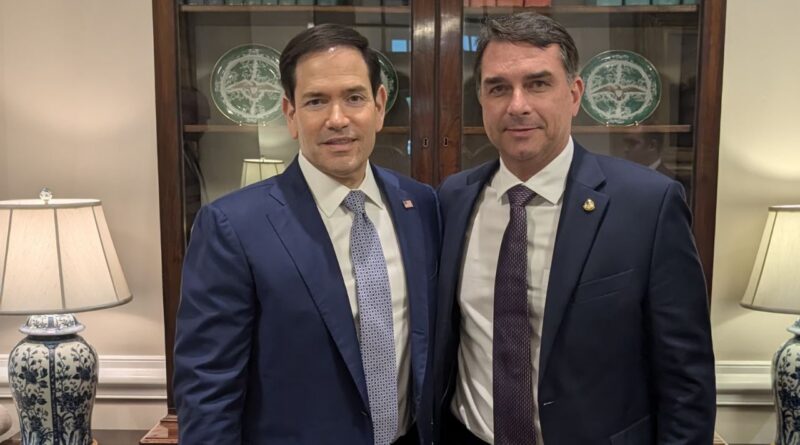
It is no coincidence that Flávio Bolsonaro met with Trump, Vance, and Secretary of State Marco Rubio in Washington in May. In September, Trump himself stated that he was following the Brazilian elections “very closely.” Furthermore, Bolsonaro’s advisors have told the press that they intend to carry out a “Marco Rubio-style reform” within the Brazilian diplomatic service.
Brazil’s intelligence agency, ABIN, has already informed the Presidency and the Superior Electoral Court about the possibility of US interference in the electoral process. The Attorney General’s Office has also notified the Federal Supreme Court about foreign funds used in Bolsonaro’s campaign. A few days ago, President Lula da Silva, who is running for reelection, used his speech at the opening of the UN General Assembly to warn that interference would not be tolerated and that “Brazil will not be anyone’s backyard.” For the moment, known efforts to block US interference are limited to the political and rhetorical spheres. But they may not be enough.
As of January 3, 2026, Latin America is a region surrounded by and under the constant threat of the Monroe Doctrine. The United States' decision to designate two Brazilian organized crime groups—Comando Vermelho (Red Command) and Primeiro Comando da Capital (Primeiro Comando da Capital)—as terrorist organizations sets a precedent for US military interventions on Brazilian soil. If Lula da Silva wins, Washington is expected to either refuse to recognize the Brazilian electoral process or remain silent on the matter. At the very least, this would keep Bolsonaro's supporters united and mobilized—supporters who, on a previous occasion, attempted to seize executive power through a coup. If Lula da Silva loses, it is already clear that Brazil would join the ranks of subservient nations, surrendering its sovereignty and natural resources out of mere ideological loyalty. If Lula da Silva wins, the first years of his new government – at least until the next elections in the United States – are likely to remain tense, under threat, and in resistance to Trump's agenda on the continent.
Miguel Enrique Stedile He has a doctorate in History from the Federal University of Rio Grande do Sul and co-president of the Department of Historical Sociology of the Tricontinental Institute for Social Research. This article is published in collaboration with Globetrotter